
Subtotal $0.00

Dark Web Monitoring Tools: How Businesses Detect Data Leaks
In today’s fast-growing digital world, businesses rely heavily on online systems, cloud platforms, social media accounts, customer databases, and digital communication tools. While technology has improved productivity and connectivity, it has also created new cybersecurity risks. Cybercriminals are constantly searching for vulnerabilities to steal sensitive information such as login credentials, financial data, customer records, confidential documents, and social media account access. One of the biggest places where stolen information is traded is the dark web. This hidden part of the internet has become a major hub for cybercrime activities, including selling hacked databases, leaked passwords, phishing kits, ransomware tools, and business credentials. Because of this growing threat, companies are now investing in advanced dark web monitoring tools, ethical hacking services, cybersecurity monitoring solutions, and social media monitoring tools to detect data leaks before they cause major damage. Businesses today understand that cybersecurity is no longer just about installing antivirus software; it is about proactive protection, continuous monitoring, and early threat detection.
What is the Dark Web?
The internet is much larger than what people normally access through search engines like Google or Bing. Most users only interact with the surface web, which includes websites, blogs, online stores, and social media platforms. However, beneath the surface web lies the deep web and the dark web. The dark web is a hidden section of the internet that requires specialized browsers like Tor to access. Unlike normal websites, dark web platforms are anonymous and difficult to track, making them attractive for cybercriminal activities. Hackers use these hidden marketplaces to trade stolen information, malware, social media credentials, financial records, and hacking tools. Businesses that ignore dark web threats often fail to realize their data has been leaked until customers begin reporting fraud or unauthorized access. This is why dark web monitoring, cyber threat intelligence, ethical hacking, and online reputation monitoring have become essential parts of modern cybersecurity strategies.
- Hidden part of the internet
- Used for anonymous activities
- Popular for cybercrime marketplaces
- Stores stolen passwords and leaked data
- Difficult to monitor without advanced tools
Why Businesses Need Dark Web Monitoring Tools
Modern businesses are exposed to cyber threats every day. Attackers no longer target only large corporations; small businesses, startups, influencers, and e-commerce brands are also vulnerable. Cybercriminals often steal employee credentials through phishing attacks, malware, or weak passwords and then upload that information to dark web marketplaces. Once leaked, the stolen data can be used for identity theft, ransomware attacks, financial fraud, or unauthorized access to company systems. Dark web monitoring tools help businesses detect these leaks early by scanning underground forums, hacker communities, and hidden marketplaces for exposed information related to the company. By combining ethical hacking services, penetration testing, social media monitoring, and cybersecurity monitoring tools, businesses can create a stronger defense system against evolving threats.
- Detects leaked passwords and credentials
- Protects customer and employee data
- Reduces risk of financial fraud
- Prevents reputation damage
- Improves overall cybersecurity posture
How Data Leaks Happen
Data leaks happen through multiple attack methods, and cybercriminals are becoming more sophisticated every year. One of the most common methods is phishing, where attackers trick users into entering sensitive information on fake websites or malicious links. Another major cause is weak passwords, as many users still reuse the same credentials across multiple platforms. Malware and ransomware attacks also contribute significantly to data breaches by stealing information directly from infected devices. Social media platforms have become another major target because hackers can exploit personal information, impersonate brands, or spread malicious links through fake accounts. Businesses that lack proper social media monitoring tools, ethical hacking assessments, and cybersecurity monitoring systems are more vulnerable to these attacks. Once data is stolen, it is frequently sold on the dark web to other cybercriminals.
- Phishing attacks steal credentials
- Weak passwords increase vulnerability
- Malware silently collects sensitive data
- Social media scams target businesses
- Insider threats can expose confidential data
What Are Dark Web Monitoring Tools?
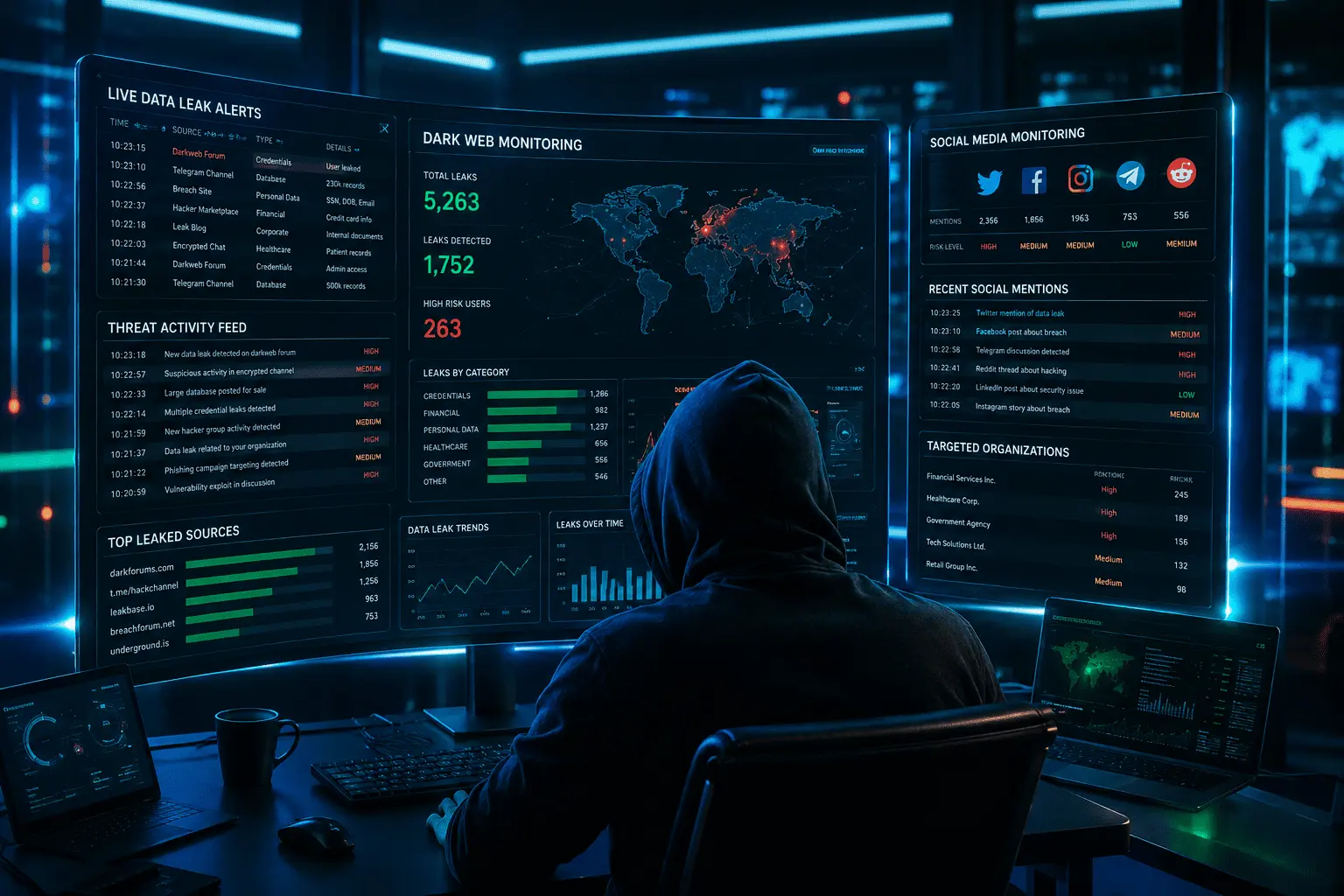
Dark web monitoring tools are specialized cybersecurity solutions designed to scan hidden online platforms and identify leaked information connected to businesses or individuals. These tools continuously monitor dark web forums, hacker marketplaces, paste sites, and underground communities for sensitive information such as employee email addresses, passwords, customer databases, financial records, and social media credentials. When leaked information is detected, the business receives a real-time alert so security teams can respond quickly. Many advanced monitoring platforms also integrate with ethical hacking services, cyber threat intelligence systems, and social media monitoring tools to provide complete protection against modern cyber threats. Instead of waiting for a cyberattack to happen, businesses can take proactive action before serious damage occurs.
- Scans hidden hacker marketplaces
- Detects leaked credentials and databases
- Sends real-time alerts
- Supports proactive cybersecurity
- Integrates with cyber threat intelligence
How Dark Web Monitoring Works
Dark web monitoring systems use automated technologies, AI-driven analysis, and cyber intelligence tools to track stolen information across hidden networks. The process starts with data crawling, where bots scan underground websites, forums, and marketplaces looking for leaked business data. The system then performs keyword tracking using company names, email addresses, domains, passwords, and social media accounts. If suspicious information appears online, the monitoring tool generates an alert. Security teams can then analyze the threat, determine the severity of the leak, and immediately take action such as forcing password resets, locking compromised accounts, or conducting ethical hacking assessments. Businesses that combine dark web monitoring, ethical hacking, penetration testing, and social media monitoring gain a stronger defense against cyber threats.
- Automated bots scan dark web sources
- Tracks company-related keywords
- Detects leaked credentials quickly
- Provides real-time threat alerts
- Helps security teams respond faster
Role of Ethical Hacking in Data Leak Prevention
Ethical hacking plays a critical role in modern cybersecurity because it allows businesses to identify vulnerabilities before cybercriminals exploit them. Ethical hackers simulate real-world attacks to test system security, social media account protection, employee awareness, and network vulnerabilities. Through penetration testing and vulnerability assessments, businesses can discover weak points that may lead to data leaks or account compromise. Ethical hacking services are especially valuable when combined with dark web monitoring tools and social media monitoring solutions, as they help organizations move from reactive security to proactive threat prevention. In 2026, companies that invest in ethical hacking and cybersecurity monitoring are significantly more prepared for evolving cyber threats.
- Identifies security weaknesses
- Simulates real-world cyberattacks
- Improves password and account protection
- Supports penetration testing services
- Reduces chances of future breaches
Importance of Social Media Monitoring
Social media has become one of the biggest targets for cybercriminals because platforms like Instagram, Facebook, LinkedIn, and Twitter contain valuable personal and business information. Attackers create fake profiles, impersonate brands, spread phishing links, and launch reputation attacks through social channels. Businesses that ignore social media security often experience account takeovers, customer scams, or brand trust issues. Social media monitoring tools help organizations track suspicious mentions, fake accounts, harmful links, and unusual online activity in real time. When integrated with dark web monitoring tools, cyber threat intelligence, and ethical hacking services, social media monitoring becomes a powerful layer of cybersecurity protection.
- Detects fake accounts and impersonation
- Tracks phishing campaigns
- Protects brand reputation online
- Identifies suspicious social activity
- Supports online reputation monitoring
Benefits of Dark Web Monitoring Tools
Dark web monitoring tools provide businesses with a proactive approach to cybersecurity by identifying threats before they become major incidents. Instead of discovering a breach after customer complaints or financial loss, companies can receive early warnings and respond immediately. These tools also help organizations improve compliance, reduce reputational risks, and strengthen overall digital security. Businesses that integrate ethical hacking services, cyber threat intelligence, penetration testing, and social media monitoring into their cybersecurity strategy are more capable of preventing data leaks and protecting sensitive information.
- Early breach detection
- Faster incident response
- Improved customer trust
- Reduced financial losses
- Better cybersecurity visibility
Conclusion
Cybersecurity threats continue to evolve rapidly, and businesses can no longer depend on traditional security solutions alone. The dark web has become a major marketplace for stolen data, leaked credentials, and cybercriminal activity. As a result, companies must adopt advanced cybersecurity strategies that include dark web monitoring tools, ethical hacking services, social media monitoring, penetration testing, and cyber threat intelligence. These solutions help organizations detect threats early, respond faster, and protect valuable business data from cybercriminals. In 2026 and beyond, proactive cybersecurity will be one of the most important investments businesses can make to secure their digital future.
- Cyber threats are constantly evolving
- Dark web monitoring provides proactive protection
- Ethical hacking improves cybersecurity strength
- Social media monitoring protects online identity
- Early detection reduces business risk dramatically
Frequently Asked Questions
Q1. What are dark web monitoring tools?
Dark web monitoring tools are cybersecurity solutions that scan hidden online platforms, hacker forums, and underground marketplaces to detect leaked business data, stolen credentials, and sensitive information before cybercriminals misuse it. These tools help organizations improve cyber threat intelligence, data leak detection, and online security monitoring.
Q2. Why is dark web monitoring important for businesses?
Dark web monitoring is important because businesses are frequent targets of cyberattacks, phishing scams, ransomware, and credential theft. These tools help companies identify data breaches early, protect customer information, reduce financial losses, and strengthen overall cybersecurity protection.
Q3. How do hackers steal business data?
Hackers use multiple methods such as phishing attacks, malware, ransomware, weak passwords, social engineering, and social media scams to steal sensitive information. Once data is stolen, it is often sold on the dark web or used for financial fraud and identity theft.
Q4. What is the role of ethical hacking in cybersecurity?
Ethical hacking helps businesses identify vulnerabilities before cybercriminals exploit them. Ethical hackers perform penetration testing, vulnerability assessments, and security audits to improve system protection and prevent future data breaches.
Q5. How does social media monitoring improve cybersecurity?
Social media monitoring tools track suspicious activities, fake profiles, phishing links, impersonation attempts, and harmful brand mentions across social platforms. This helps businesses protect their online reputation and reduce social media-related cyber threats.
Q6. What types of information are commonly leaked on the dark web?
The most common leaked information includes:
- Email addresses
- Passwords
- Financial records
- Customer databases
- Social media credentials
- Business documents