
Subtotal $0.00

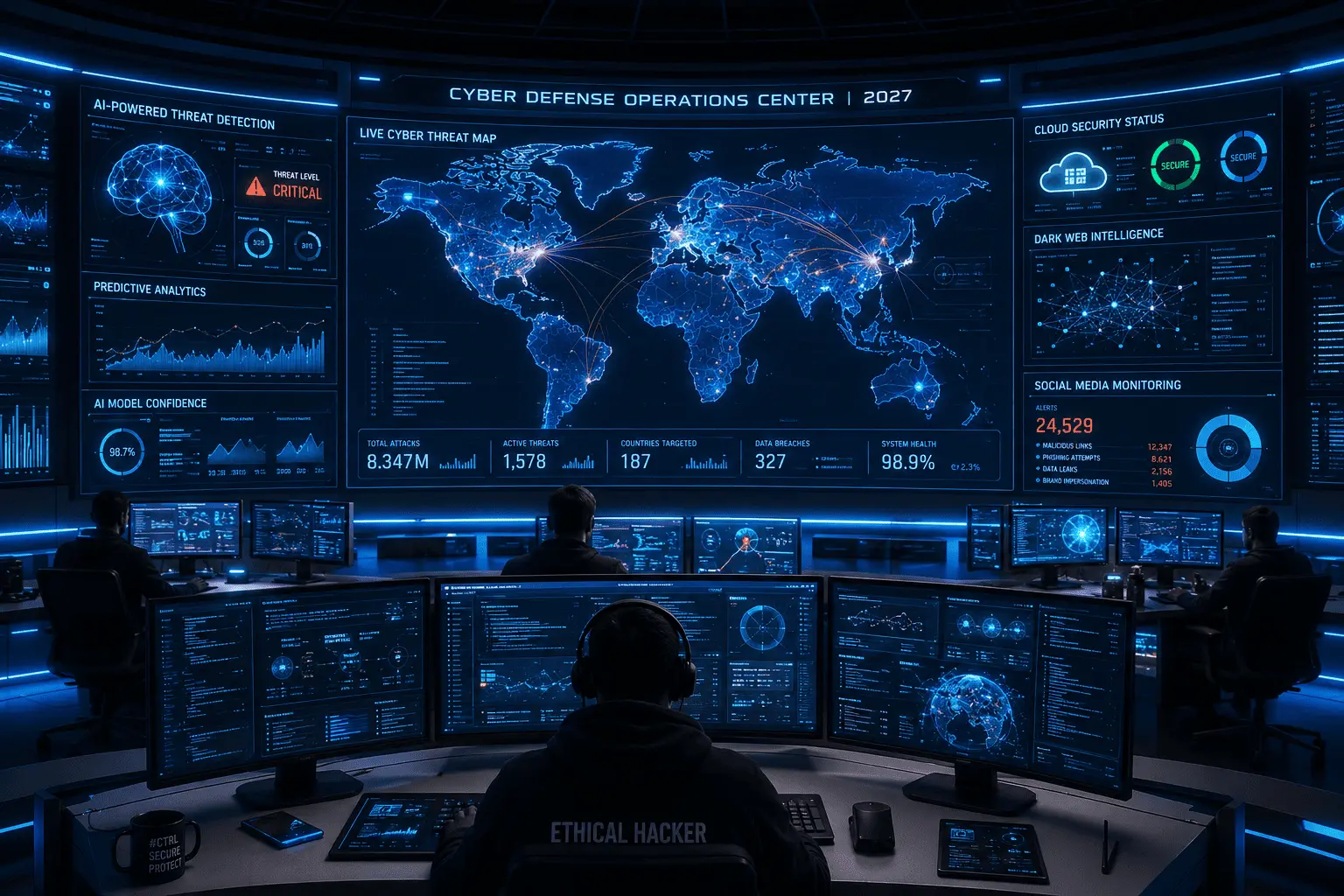
Companies are turning to artificial intelligence, cloud computing, remote employment, the Internet of Things (IoT) and digital transformation. Cybersecurity is faster than ever. Technology continues to drive productivity and innovation, but it also provides new opportunities for cyber criminals. Cybersecurity experts are warning of more sophisticated attacks in 2027 that will be driven by artificial intelligence, automated hacking tools, ransomware-as-a-service (RaaS), deepfake fraud, cloud security gaps, identity-based attacks and complex social engineering efforts.
Targeted cyber-attacks are expected to increase in big technology and financial centres including New York, London, Singapore, Dubai, Toronto, Sydney, Bangalore, Mumbai, Delhi and Hyderabad. To protect their assets, companies are investing into cybersecurity services, ethical hacking services, penetration testing, cloud security, cyber threat intelligence, social media monitoring, dark web monitoring, vulnerability assessment and AI-powered cybersecurity solutions.
We review the top cybersecurity predictions for 2027, the technologies fueling digital security, and the best practices to help businesses stay ahead of evolving cyber risks.
The Future of Cybersecurity in 2027
It is not simply about antivirus software and firewalls anymore. Organizations today need to be proactive and includ
AI, automation, threat intelligence, ongoing surveillance, and ethical hacking in their security plans. In 2027, security teams will be more focused on predicting attacks, rather than responding to them.
The companies will increase the use of AI-based cybersecurity tools, cyber threat intelligence platforms, cloud security monitoring, social media monitoring tools, identity protection solutions, and ethical hacking services to detect suspicious activity before they become serious incidents.
- AI will be ubiquitous in the cybersecurity field.
- More automated detection of threats
- “Cloud security will become a business imperative.
- The security checks will be continuous and not periodic.
Cyber resilience will be more important than prevention.”
Prediction 1: AI-Powered Cyber Attacks Will Increase
Artificial Intelligence is helping security professionals defend networks, but cybercriminals are also using AI to launch more sophisticated attacks. AI-generated phishing emails, automated malware, deepfake scams, and intelligent password attacks are expected to become even more common in 2027.
Attackers will use AI to analyze public information, personalize phishing campaigns, generate fake voice recordings, and identify security weaknesses faster than ever before.
Businesses should invest in AI cybersecurity, ethical hacking services, penetration testing, cyber threat intelligence, and employee security awareness training to reduce these risks.
- AI phishing attacks will become more convincing.
- AI malware will adapt to security defenses.
- Voice cloning scams will increase.
- Automated hacking tools will become more advanced.
Prediction 2: Cloud Security Will Become the Top Priority
More organizations are moving applications and data to cloud environments, making cloud infrastructure one of the biggest targets for cybercriminals. Cloud misconfigurations, weak access controls, and insecure APIs will continue to be major causes of data breaches.
Businesses in London, New York, Singapore, Dubai, Sydney, Bangalore, Mumbai, Delhi, and Toronto are expected to increase investments in cloud security solutions, Identity and Access Management (IAM), Zero Trust Security, Multi-Factor Authentication (MFA), and cloud security monitoring.
- Cloud attacks will continue to rise.
- Secure cloud configuration will be essential.
- Identity protection will become more important.
- API security will receive greater attention.
Prediction 3: Passwordless Authentication Will Replace Traditional Passwords
Poor passwords are still among the greatest cyber security threats. Passwordless authentication will be used by more organizations by 2027, including biometrics, passkeys, hardware security keys and adaptive authentication.
This change will dramatically reduce credential theft and phishing attacks, while also improving user satisfaction.
- Passwords will be a thing of the past.
- Biometrics are going to be more common.
- Forget login’s. “Passkeys are the future.”
- Improved identity protection.
Prediction 4: Ransomware Will Become More Intelligent
Ransomware attacks are expected to become faster, more automated, and highly targeted. Instead of attacking thousands of organizations randomly, cybercriminals will focus on high-value businesses, government agencies, hospitals, and financial institutions.
Organizations using ethical hacking services, vulnerability assessments, cybersecurity monitoring, dark web monitoring, and penetration testing will be better prepared to defend against ransomware campaigns.
- Ransomware attacks will become more targeted.
- AI will improve attack automation.
- Data theft will increase before encryption.
- Backup strategies will become critical.
Prediction 5: Social Media Will Become a Bigger Cybersecurity Threat
Cybercriminals are increasingly using LinkedIn, Facebook, Instagram, X (Twitter), and other platforms for social engineering attacks, fake recruitment campaigns, phishing, and brand impersonation.
Businesses will rely more heavily on social media monitoring tools, online reputation monitoring, cyber threat intelligence, and digital risk protection to identify threats before they impact operations.
- Fake profiles will increase.
- Brand impersonation will become more sophisticated.
- AI-generated scams will spread across social platforms.
- Social engineering attacks will become more personalized.
Prediction 6: Dark Web Monitoring Will Become Standard Practice
The dark web will continue to serve as a marketplace for stolen credentials, customer databases, intellectual property, and ransomware tools.
Organizations will increasingly adopt dark web monitoring tools, cyber threat intelligence platforms, ethical hacking services, and identity monitoring solutions to identify leaked information before criminals exploit it.
- More business data will appear on the dark web.
- Early detection will reduce financial losses.
- Credential monitoring will become essential.
- Threat intelligence will improve incident response.
Prediction 7: Ethical Hacking Will Be More Important Than Ever
Organizations will continue increasing investments in ethical hacking services, penetration testing, vulnerability assessments, red team exercises, and security audits as proactive cybersecurity becomes more valuable than reactive defense.
Ethical hackers will increasingly use AI-powered testing tools to identify vulnerabilities faster while still relying on human expertise for complex attack simulations.
- Ethical hacking demand will continue growing.
- Penetration testing will become more frequent.
- AI will support vulnerability discovery.
- Security assessments will become continuous.
Prediction 8: Zero Trust Security Will Become the Global Standard
The traditional “trust but verify” model is rapidly disappearing. Zero Trust assumes that every user, device, and application must be verified before access is granted.
Businesses across New York, London, Singapore, Dubai, Toronto, Sydney, Bangalore, Mumbai, Delhi, and Hyderabad are expected to implement Zero Trust Security, Identity and Access Management, Multi-Factor Authentication, cloud security, and continuous authentication as core cybersecurity strategies.
- Continuous verification will replace traditional trust.
- Identity protection will become central.
- Access controls will become more granular.
- Insider threats will decrease.
Best Practices to Prepare for 2027
Businesses should start strengthening their cybersecurity programs today rather than waiting for future threats.
Recommended actions include:
- Implement Zero Trust Security.
- Conduct regular penetration testing.
- Hire ethical hacking services.
- Use cloud security monitoring.
- Enable Multi-Factor Authentication.
- Invest in cyber threat intelligence.
- Deploy dark web monitoring tools.
- Monitor social media for cyber threats.
- Train employees regularly.
- Maintain secure cloud backups.
Key Takeaways
- AI-powered cyber attacks will get more and more sophisticated.
- Cloud security will continue to be a priority in the area of cybersecurity.
- Passwordless authentication is going to replace passwords.
- Ransomware attacks will be more focused.
- Cybersecurity will have a new function – social media monitoring.
- Dark web monitoring will become the norm for many businesses.
There will be more importance given to ethical hacking and penetration testing.
Zero Trust Security will be the security architecture of choice.
Frequently Asked Questions
What are the top cybersecurity predictions in 2027?
AI-powered attacks, ransomware evolution, cloud security, Zero Trust, and passwordless authentication will lead the way.
Why will AI become more important for cybersecurity?
AI helps improve threat detection, automation, predictive analysis and incident response. Attackers also use AI to execute more advanced cyber attacks.
What is Zero Trust Security?
Zero Trust is a security approach that always checks each user and device before allowing access.
Will we have to use passwords in the future?
We can anticipate more passwordless authentication using passkeys and biometrics.
Why is cloud security becoming a big issue?
As more and more data and applications are moving to the cloud by businesses, it is a must to secure cloud infrastructure.
How does ethical hacking help businesses?
Ethical hackers identify vulnerabilities before cybercriminals exploit them through penetration testing and security assessments.
hy is social media monitoring important for cybersecurity?
It helps detect fake accounts, phishing campaigns, executive impersonation, and social engineering attacks.
What is dark web monitoring?
Dark web monitoring identifies stolen credentials, leaked business data, and cyber threats hidden within underground marketplaces.
Which industries will face the biggest cybersecurity risks in 2027?
Finance, healthcare, e-commerce, SaaS, manufacturing, government, education, and technology organizations will remain high-risk targets.
How can businesses prepare for future cyber threats?
By combining ethical hacking services, penetration testing, cloud security, cyber threat intelligence, social media monitoring, dark web monitoring, employee training, and Zero Trust Security into a comprehensive cybersecurity strategy.